Interaction-based multi-objective quality assessment for task-specific vacuum grasping
Georg Siegemund, Florian Hecht, Franz Dietrich
CIRP Global Web Conference 2026 (CIRPe 2026) — Procedia CIRP · 2026
Introduction
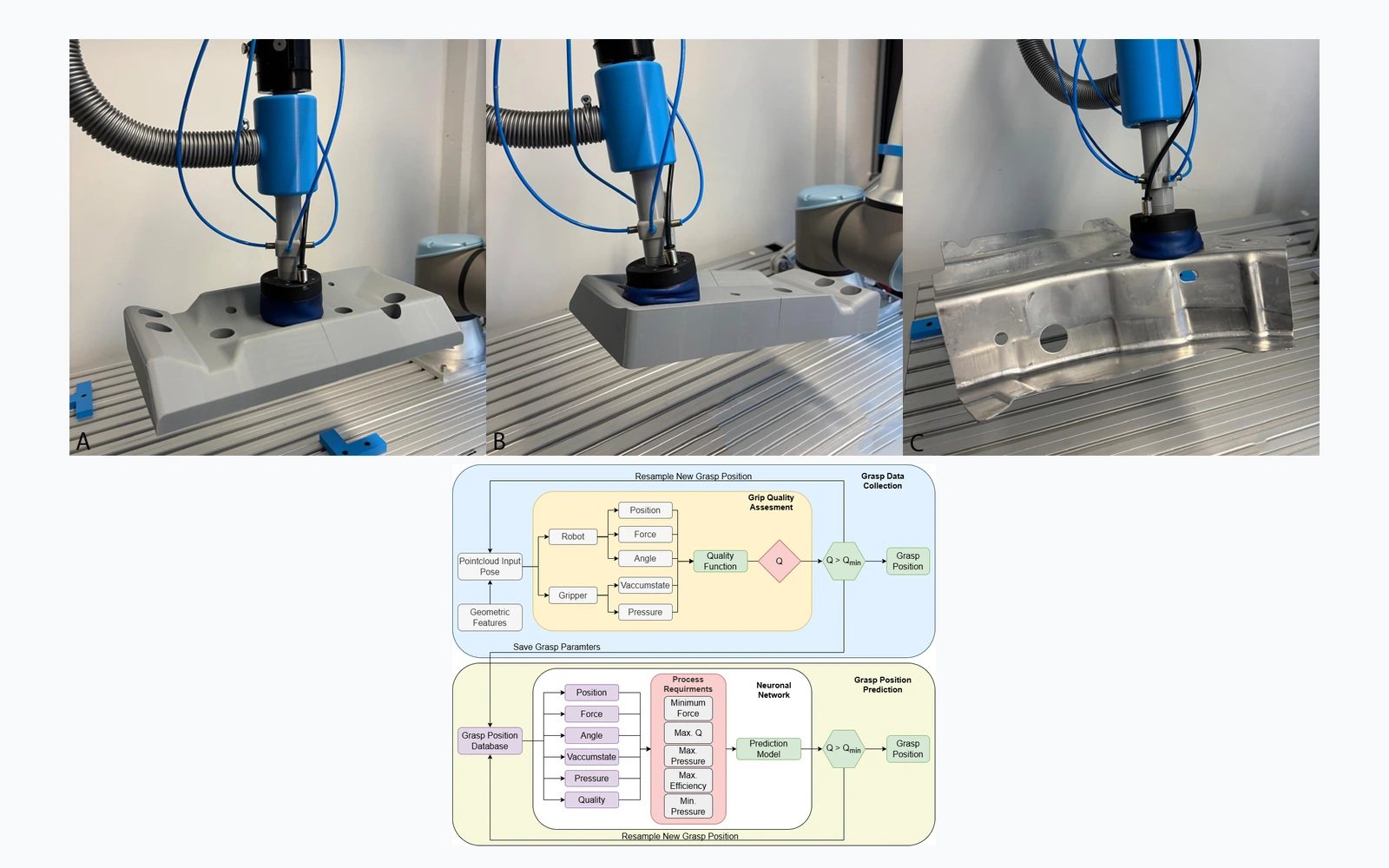
A geometrically promising suction position is not necessarily the best position once the gripper physically interacts with the object.
Seal formation, leakage, pressure distribution, suction effort, contact force, and local compliance only become observable during the actual grasp. This work introduces an interaction-based, multi-objective framework for evaluating and re-ranking vacuum grasp candidates according to the requirements of a specific handling task.
At a glance
Geometric grasp planning and vacuum thresholds provide useful feasibility information but do not fully describe how robust, efficient, or gentle a grasp is.
Point-cloud-generated candidates are physically executed. Sensor information is transformed into several interpretable grasp-quality components and combined differently depending on the task.
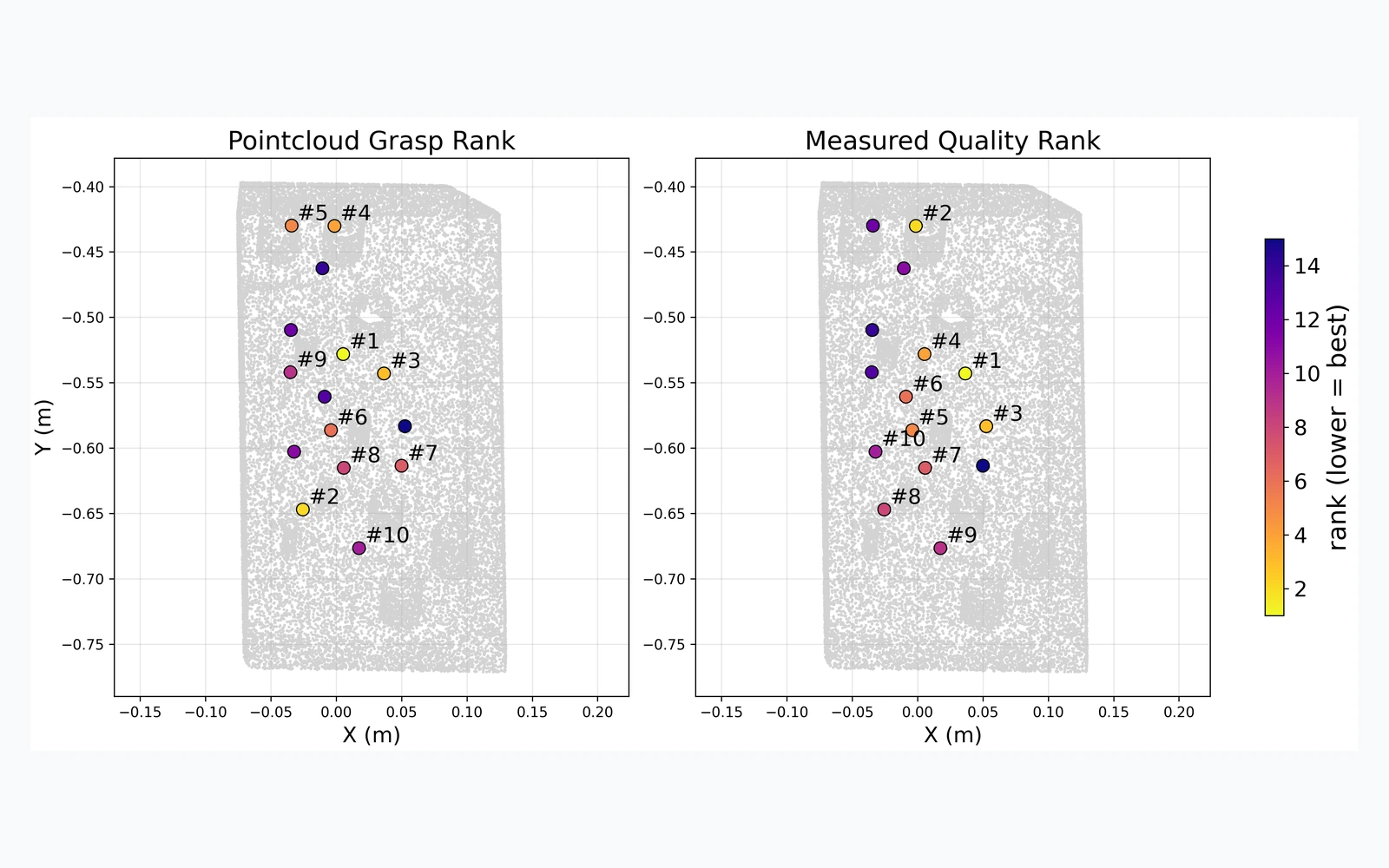
Only 7.7% top-1 agreement was observed between the initial geometric ranking and the measured interaction-based ranking, showing that physical interaction provides important information that geometry alone cannot capture.
Beyond binary grasp success
Two successful grasps can behave very differently: one may require more suction power, another may create excessive force on the object, and a third may form a more uniform and robust seal.
A simple success/failure label loses this information, even though it is directly relevant to industrial process design.
A multi-objective grasp quality
Grasp quality is broken down into five interpretable components: seal strength, pressure uniformity, suction efficiency, gentle handling (low interaction force), and geometric robustness.
Each component captures a different aspect of how the grasp actually behaved during execution, rather than a single aggregate score.
Geometry proposes, interaction evaluates
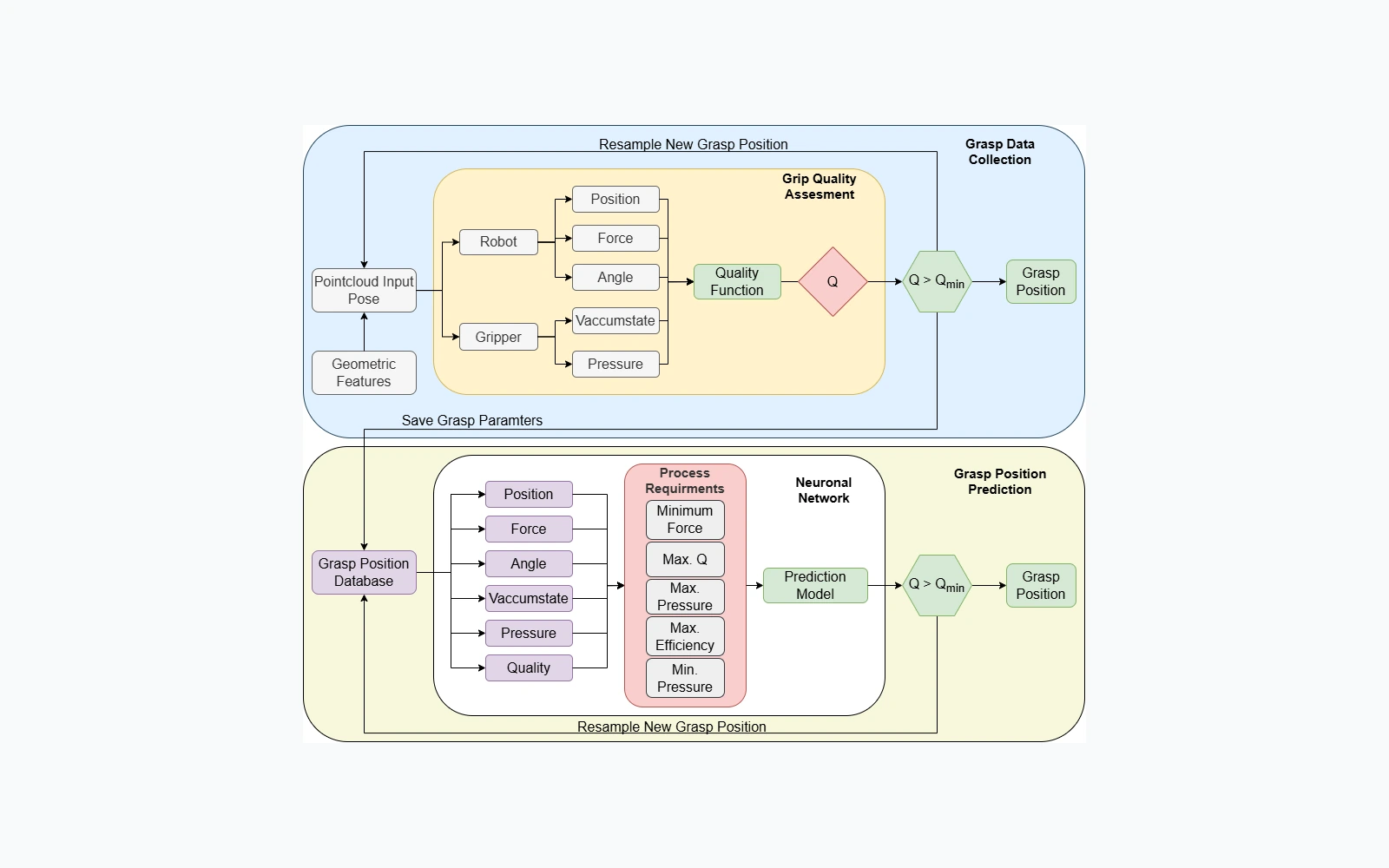
The framework works in two stages. First, point-cloud geometry generates plausible grasp candidates for a given object.
Second, these candidates are physically executed and evaluated using real pressure, force, pose, gripper orientation, and suction-command data, producing a measured quality label that can re-rank the original candidate set.
Task-specific grasp selection
The best grasp depends on what the process actually values — robust transport, energy-efficient handling, gentle handling, or precision placement can each favour a different grasp position from the same candidate set.
Weighting the five quality components differently therefore allows the same measured database to serve different task requirements.
Learning from measured grasps
The resulting grasp database, built from physically measured quality labels, can be used as training data for a prediction model.
This demonstrates how measured grasp quality could eventually guide a robot toward promising grasp regions without exhaustively testing every position.
Figures
Citation
Siegemund, G., Hecht, F., & Dietrich, F. (2026). Interaction-based multi-objective quality assessment for task-specific vacuum grasping. Procedia CIRP — CIRP Global Web Conference 2026 (CIRPe 2026).
Related projects
Interested in a research collaboration?
Get in touch to discuss joint research, data collection, or applied evaluation of new methods.