Adaptive Leakage-Aware Grasp Optimization for Flexible Granular Vacuum Grippers
Georg Siegemund, Frederik Hoeft, Arne Glodde, Franz Dietrich
11th CIRP Conference on Assembly Technologies and Systems (CATS 2026) — Procedia CIRP · 2026
Introduction
Flexible granular vacuum grippers can adapt to a wide range of object geometries, but their performance depends strongly on achieving an airtight seal. Leakage at edges, openings, textured surfaces, or during a misaligned approach can significantly reduce grasp reliability.
This work investigates whether a small number of pressure sensors integrated into the gripper can provide not only a global indication of leakage, but also information about where the leakage occurs.
At a glance
Conventional vacuum monitoring can detect insufficient vacuum but provides little information about the location or type of leakage.
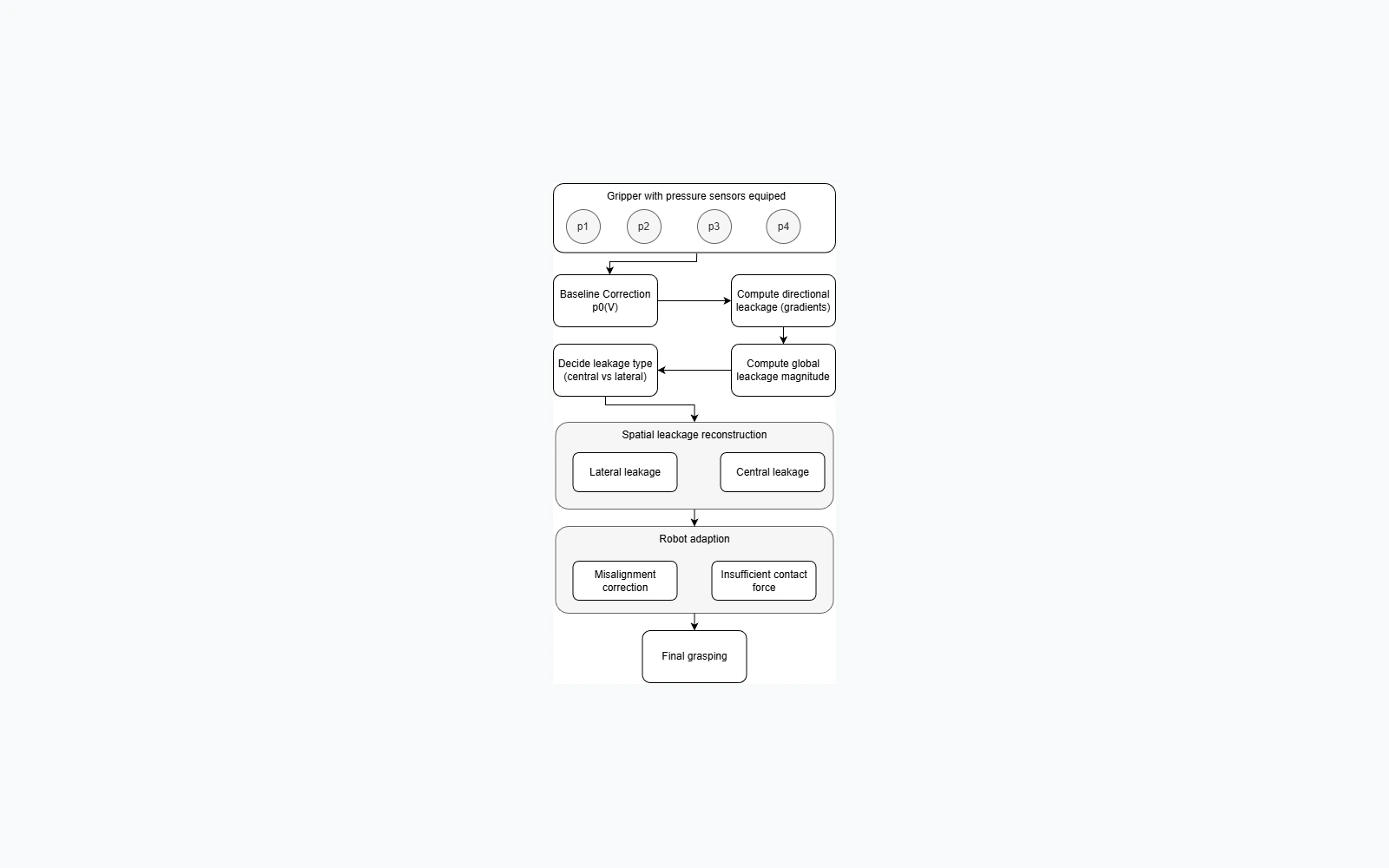
Four pressure sensors positioned around the gripper membrane are compared against a calibrated baseline. Directional pressure deviations and global leakage magnitude are used to distinguish lateral from central leakage and reconstruct a spatial leakage field.
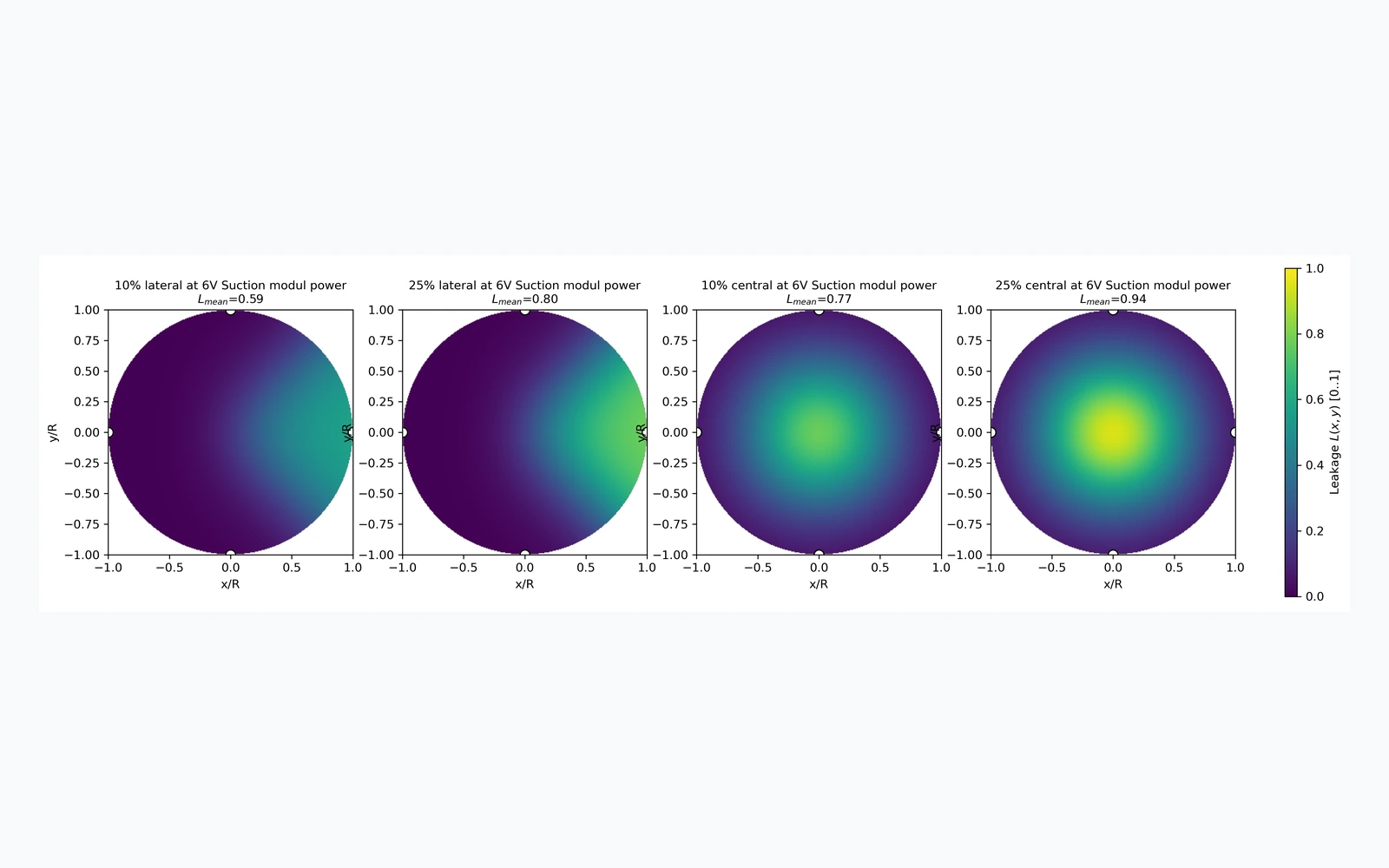
The experiments showed reliable differentiation between lateral and central leakage across the evaluated conditions. The reconstructed field provides information that can be translated directly into robot corrections.
Localising leakage instead of only detecting it
A conventional global pressure value can indicate that sealing is poor, but it cannot tell the controller whether the problem comes from lateral misalignment or insufficient contact in the centre of the gripper.
The distributed sensing concept used in this work relies on four internal pressure measurements to obtain spatial information without adding an external vision or tactile system.
From pressure signals to a leakage field
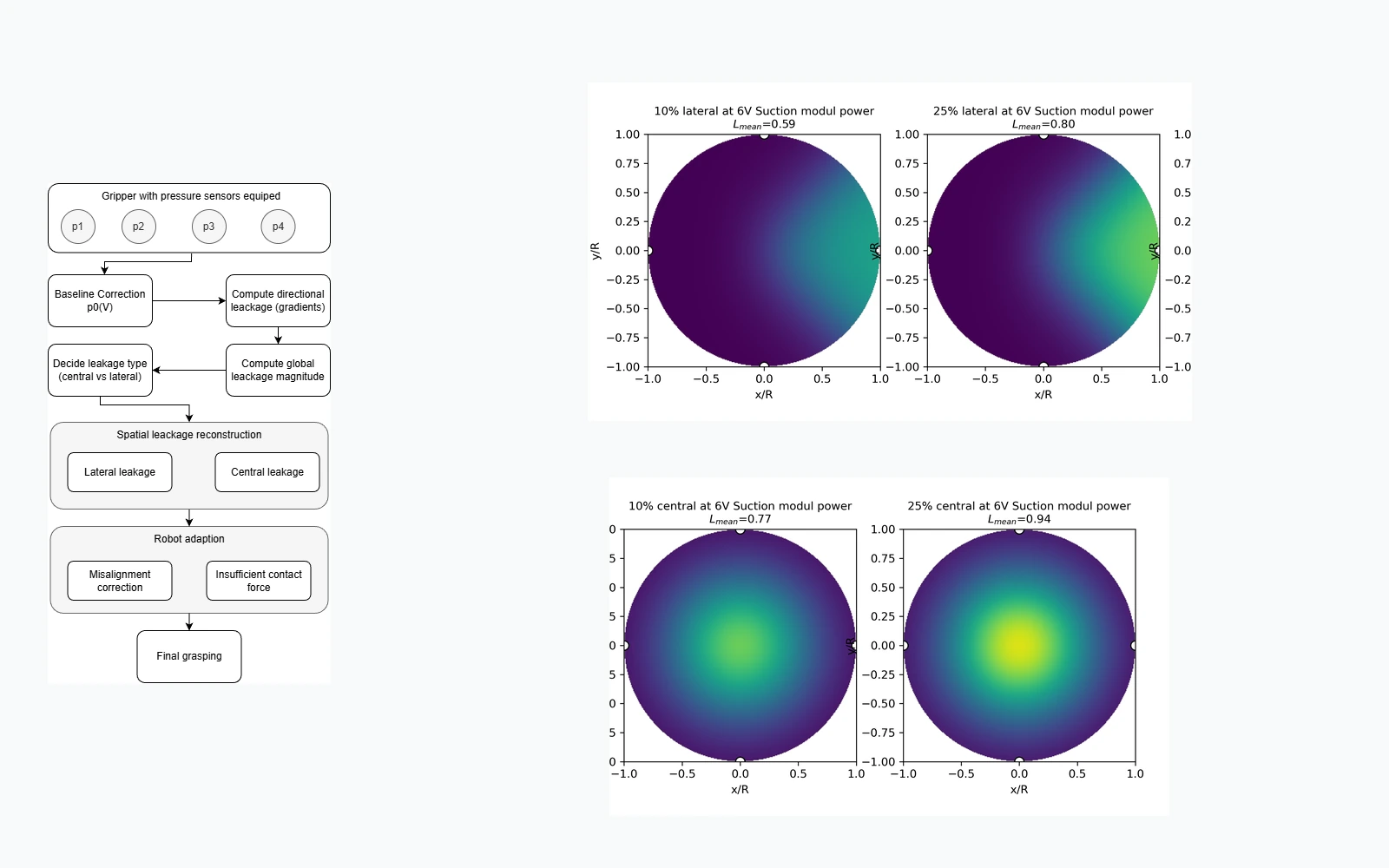
The processing pipeline moves from raw sensor readings to an actionable robot correction. Pressure readings from the four sensors are first corrected against a calibrated baseline, then converted into directional leakage gradients and an overall leakage magnitude.
This information is used to classify the leakage as lateral or central and to reconstruct a spatial leakage field, which is then translated into a concrete adjustment for the robot.
Using leakage information for robot adaptation
Directional, lateral leakage indicates that the end effector can be shifted in-plane to improve alignment with the object.
Central leakage indicates that additional contact force, more compliance, or an adjusted approach angle may be required instead.
Once the readings indicate a sealed condition, the gripper can proceed confidently with the final jamming phase that locks the granular medium in place.
Experimental evaluation
The approach was evaluated across different leakage configurations, suction settings, and loading conditions. The reconstructed leakage fields consistently reflected whether the leakage originated laterally or centrally, matching the intended failure mode in each test case.
Why it matters
The approach provides a lightweight sensing layer between simple global vacuum monitoring and much more complex tactile or vision systems.
It could ultimately support closed-loop grasp formation, in which the robot actively searches for a better seal before committing to the final grasp.
Figures
Citation
Siegemund, G., Hoeft, F., Glodde, A., & Dietrich, F. (2026). Adaptive Leakage-Aware Grasp Optimization for Flexible Granular Vacuum Grippers. Procedia CIRP — 11th CIRP Conference on Assembly Technologies and Systems (CATS 2026).
Related projects
Interested in a research collaboration?
Get in touch to discuss joint research, data collection, or applied evaluation of new methods.