Automated Precision Assembly
Development of a partially automated assembly process for mo.blaze tens motorcycle indicators, integrating plasma surface treatment, adhesive application, and precision glass-body insertion. The solution reduced defective parts by approximately 30%.
The challenge
The assembly of compact motorcycle indicators requires precise positioning and reliable bonding of small components.
For the mo.blaze tens indicators, the glass body was previously attached to the indicator housing manually.
This process required considerable precision and involved repetitive handling, making it susceptible to assembly errors and inconsistent results.
The objective was to automate the most demanding assembly steps while improving product quality.
Our solution
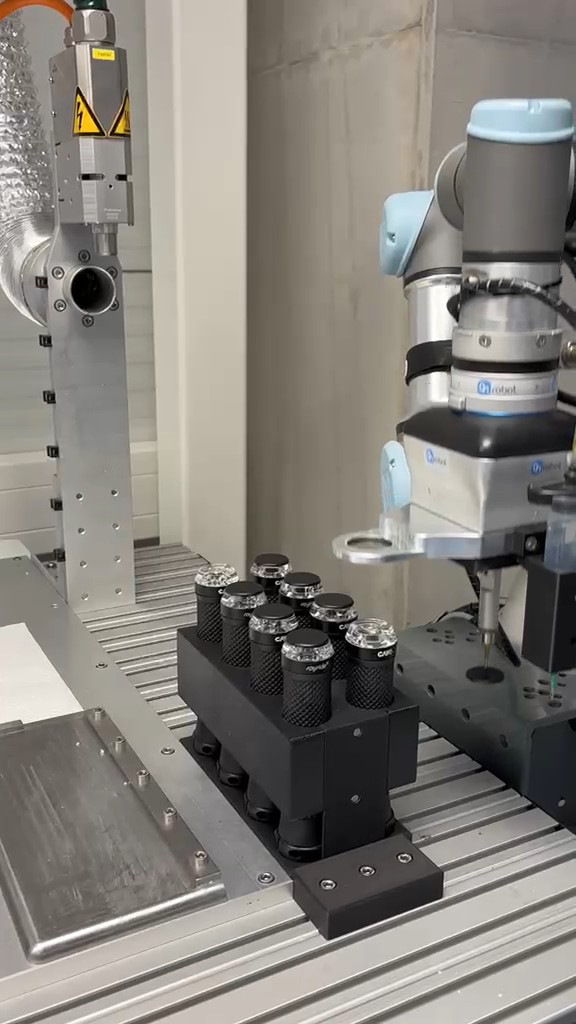
RAWDEV developed and implemented a partially automated assembly system specifically designed for the mo.blaze tens indicators.
The system combines custom-designed component holding fixtures with a coordinated assembly process.
First, the glass body is picked up and subjected to plasma surface treatment in preparation for adhesive bonding.
Adhesive is then applied before the glass body is precisely inserted into the indicator housing.
By integrating surface preparation, adhesive application, and component insertion into one controlled process, the system reduces variability associated with manual assembly.
RAWDEV was responsible for developing and implementing the complete assembly solution, including the mechanical fixtures and manufacturing process.
The result
The system successfully automated the most precision-critical and repetitive stages of the assembly process.
The number of incorrectly manufactured components was reduced by approximately 30%, improving assembly consistency and reducing production waste.
Technical highlights
- Custom-designed indicator fixtures
- Automated glass-body handling
- Integrated plasma surface treatment
- Controlled adhesive application
- Precision glass-body insertion
- Partially automated assembly process
- Approximately 30% reduction in defective parts
Have a similar challenge?
Send us your technical requirements, drawing, or project idea and we will evaluate a practical approach together.